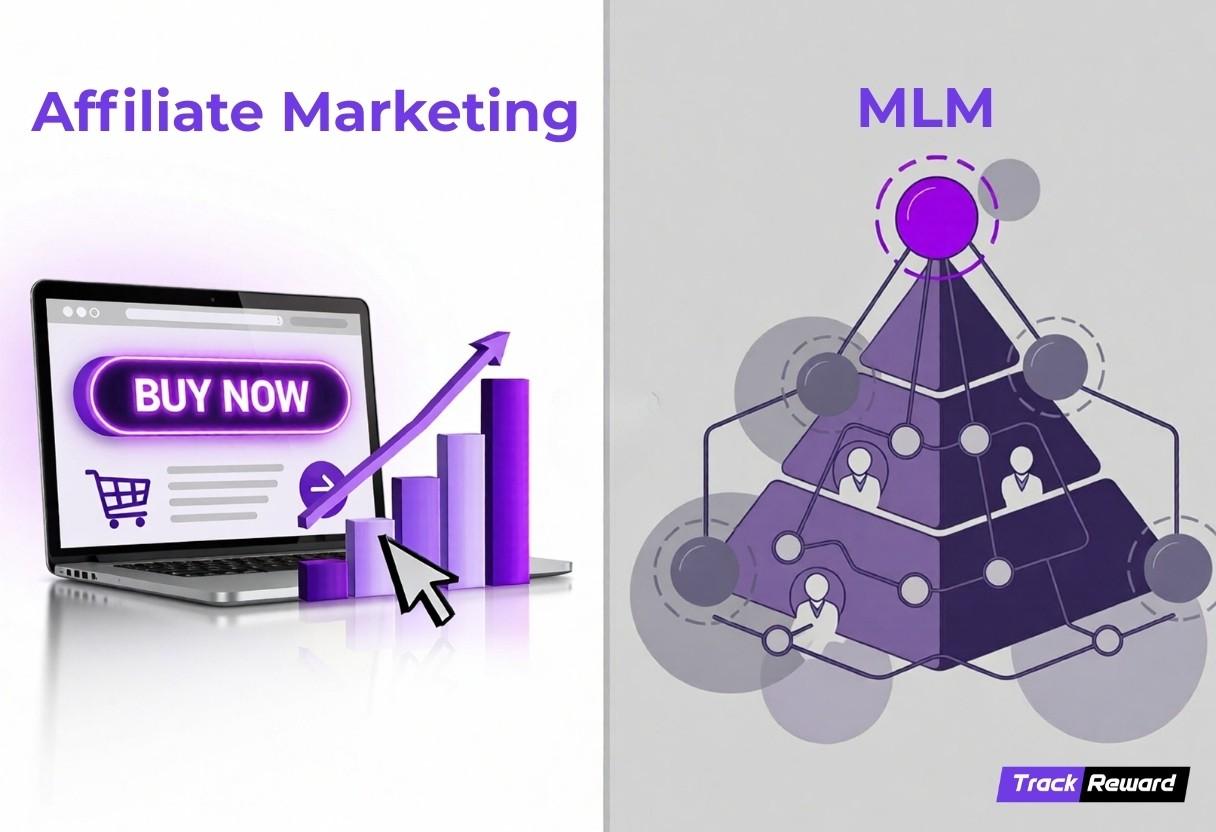
Most humans mix up affiliate marketing and MLM all the time.
Surface level, both models pay people for promoting products. They mainly talk about the 3 Ps. Partnerships. Products. Passive income. But that’s where the similarities end.
Underneath, they work very differently. One is based on actual sales. The counterpart mixes sales and recruitment. One is flexible and low risk. The other feels like running a tiny franchise inside a big company.
So, multiple factors distinguish affiliate marketing from multi-level marketing. This includes core focus, startup cost, risks, activities, and whatnot.
About Affiliate Marketing

Selling products minus owning the inventory.
Affiliate marketing is a performance-based model. You promote a product or service with an affiliate link. And you get paid only when someone buys or signs up.
Brands love this because they pay only when they get results. It's effective and scalable. Businesses make $15 for every $1 spent on affiliate marketing.
That’s a massive return, which is why 84% of brands are into affiliate programs. It shows how widely adopted it is.
Strengths
- Low-to-no Startup Cost: You can often join for free.
- Minimal Risk: Pay for marketing tools. No need to buy inventory.
- Total Flexibility: Promote multiple brands and set your own schedule.
- Builds Real Skills: Learn SEO, content creation, and digital marketing.
- Passive Income Potential: Old content can keep generating sales.
Weaknesses
-
Unpredictable Income: Traffic and commission rates can change.
-
Self-Motivation Needed: You’re running your own show.
-
Competitive: Popular niches have countless affiliates
About Multi-Level Marketing?

A sales team you build yourself.
Multi-Level Marketing is a direct sales model where you earn by selling products and recruiting others to sell.
It’s a part of the larger MLM industry, which generates $189B a year. It runs on direct sales and recruitment.
You sell products to customers and also build a team (called downline). The business earns from your personal sales and a percentage of your team’s sales.
Those recruits can then recruit others, which creates a multi-level network. That’s why we call it Network Marketing, too.
Strengths
-
Structured Training: Companies often provide scripts and sales materials.
-
Community Support: You’re a part of a team with meetings and events.
-
Theoretical Residual Income: If you build a big, active downline.
-
Recognition Systems: Public rewards, titles, and ceremonies for achieving sales milestones.
Weaknesses
-
High Upfront Costs: Starter kits and monthly quotas can add up.
-
High Financial Risk: You may have to spend more than you make.
-
Focus on Recruitment: Success depends more on downline than on selling products.
Affiliate Marketing Vs. Multi-Level Marketing Difference Table
|
Factor |
Affiliate Marketing |
MLM |
|
Core Focus |
Sales |
Sales & Recruitment |
|
Compensation |
Direct |
Multi-Tiered |
|
Startup Costs |
$0 to $1000+ |
$1000+ |
|
Flexiblity |
Promote multi-brands |
Stick to company rules |
|
Daily Work |
Content & traffic tasks |
Outreach & recruitment |
|
Financial Risks |
Low |
High |
|
Public Perception |
Trasnparent |
Controversial |
|
Operations |
No inventory |
Often needs inventory |
Key Differences Between Affiliate Marketing And Multi-Level Marketing
Core Mission
Sales Generation vs. Network Building.
Affiliate marketing has one clear goal: making sales. It revolves around product promotion. You promote, someone buys, you get paid. That’s it. Your success is measured by how well a product and a buyer connect.
Most affiliates never even meet the merchant. They just focus on content, clicks, conversions, and refining their affiliate strategy. The structure is simple enough that beginners, too, can understand how money flows.
Multi-Level Marketing has a dual mission: mixing sales with recruitment. Selling products is one part. The other part is recruiting new distributors to expand the network. Because that’s what unlocks the higher payouts.
For this, an MLM company depends heavily on the latter. Participants often put more time into recruiting than selling. The mission becomes growth through people. Not just product promotion.
Earning Blueprint
Direct Commissions vs. Layered Pay.
Your affiliate paycheck is transparent. Drive a sale for a $100 product with a 10% commission. You earn $10.
The math is simple. Earning commission for every sale you bring in. So, it’s performance-driven.
If your content brings traffic, you win. If not, you don’t earn. No layers. No surprise “maintenance fees.”
MLM compensation plans use a multi-tier commission structure. You earn from your sales, plus a small cut from your direct recruits’ sales, plus an even smaller cut from their recruits, and so on.
In practice, it’s complicated. You need to maintain ranks, meet volume quotas, or buy more products to stay qualified.
Different newcomers struggle because the main income driver is recruitment, mostly. Such a layered pay is why lots of people confuse MLM with being a pyramid-like structure.
Entry Cost
Low Barrier vs. Required Buy-In.
Starting an affiliate marketing is cheap. It can go from $0 to $100+ per year for basic setups, or $1,000+ for faster growth with paid ads.
Lots of programs are usually free to join. Your only real investments are optional: tools, websites, hosting, or ads.
You can start with nothing but a phone and time. Nobody asks you to buy products or keep monthly quotas. The financial risk stays close to zero.
MLM programs almost always require an upfront investment. A survey found that two-thirds spent $1,000+ to start their MLM business.
This is usually for a starter kit, product pack, and a joining fee. Plus, you may need ongoing purchases to keep your rank active.
Such expenses create a “sunk cost” feeling. They often stay in the program, hoping to recover the costs. This is risky, especially if the products are hard to resell.
Daily Activities
Content and Traffic Vs. Recruitment and Events.
Affiliate marketers' day is online and solo. They spend their time with-
|
Creating content |
Running ads |
|
Building email lists |
Optimizing websites |
|
Learning traffic tactics |
Filming videos |
All these are to drive traffic to their links. Your results depend on audience trust and smart marketing. And since 57% won’t recommend a business with a poor mobile website, affiliates focus on presentation and value.
An MLM distributor’s routine is more social and offline. In fact, 70% of MLM sales rely on person-to-person interactions. They-
|
Attend home, team calls, product demos, and training. |
Talk to friends, neighbors, and anyone who may buy or join. |
Recruitment becomes part of the daily routine. It’s because selling alone rarely pays well. The daily tasks depend more on social outreach than marketing skills.
Brand Relationship
Independent partner vs. Brand ambassador.
Affiliate marketers are independent promoters. They can work with multiple brands. Sometimes even with competing ones.
The affiliate network world encourages this flexibility. This means you own your
-
Audience
-
Content and
-
Personal brand
You’re not tied to a single company’s rules.
Multi-Level Marketing people are brand ambassadors or independent distributors. They typically follow company rules on pricing, product claims, and (sometimes) social media posts.
You represent one company at a time. And breaking guidelines can get your account terminated. You don’t own the customer list either.
If you leave, the company keeps everything. Your customers, your team, and your commissions.
Financial Risk
Pay-for-Results vs. Upfront Investment
Affiliate marketing is almost risk-free. Reason? It follows a pay-for-results model. Brands only pay when affiliates generate measurable performance. The best part is that they can enjoy up to 1200% return.
This makes it attractive for everyone. You don’t have to buy anything, and you don’t sit on unused products. The worst-case scenario? Earning nothing. But you also lose nothing.
In MLM, you have sunk costs before making your first sale. Several participants have to buy products to keep their rank active or maintain eligibility for bonuses. Add training events, travel, and marketing materials, and the expenses climb.
That’s why the 99% earn very little or lose money. Because recurring costs outweigh sales. Although the average MLM seller earns $35,430-ish per year, that number is heavily skewed by top earners.
Public Perception
Trust-Driven vs. Controversy-Tinged.
People like knowing who earns what. When things are clear, trust goes up fast. A study found that 71% prefer brands with the most transparency.
Affiliate marketing sits on the “transparent” side of the internet. Because ethical guidelines and legal requirements make this disclosure mandatory.
As per the stats, 88% trust apps more when affiliate partnerships are clearly disclosed. This helps affiliates. Because honest reviews and clean disclosures feel safe to buyers.
MLM gets the opposite reaction. The structure resembles pyramid selling, which creates doubts. A lot of people have had awkward experiences with friends pushing products or recruitment.
Social media doesn’t help either. So the public approaches MLM with caution.
Operational Burden
Hands-Off vs. Hands-On Logistics
Affiliate marketing is hands-off. The merchant handles shipping, customer service, returns, and complaints. Everything.
You focus on promotion only. This freedom helps you scale without extra effort.
In Multi-Level Marketing, logistics land on your shoulders. People typically keep stock to deliver faster or meet quota. You may handle packing, delivering, tracking orders, or explaining product usage.
Such tasks add time and cost. The more customers you have. The more manual work you must do. That’s why scaling feels harder. Because you're doing customer service and trying to recruit simultaneously.
Going Hybrid: Affiliate + Multi-Level Marketing
Can you mix the two? Some try.
A "hybrid" model usually means adding a tiered, recruitment-like element to an affiliate program.
How Does It Work?
Affiliates earn for their own sales. They can also get a small bonus from sales made by people they refer to the program. No money is paid for just signing people up. Commissions need actual sales.
Does It Work?
It can work well if the focus stays on sales, not recruiting. This motivates top performers to grow the program. It gives affiliates an extra income stream.
The core must remain performance-based. The moment the focus shifts to building a downline, it risks MLM problems. For instance, saturation and pressure.
If run properly, it avoids classic MLM pitfalls. There are no ranks, quotas, or forced purchases. This rewards real sales.
Warning
However, brands must be careful. Automated monitoring is needed to stop affiliate fraud like coupon theft. Clear rules can keep the program clean.
The Reality Check: Income and Success Rates
Let's talk numbers.
The average MLM seller makes about $35,430 per year. But that number is misleading. It's pulled up by a small handful of people at the very top.
For the vast majority, earnings are minimal or negative. Remember, only 25% turn a profit.
Affiliate marketing income has no such average. It's the wild west. A beginner may make $100 a month. A skilled affiliate in a good niche can make 5 or 6 figures.
The ceiling is high. But the floor is zero. Your income directly reflects your marketing skills, effort, and niche choice. There's no team to blame or rely on. It's all on you.
Which Path Should You Choose?
Choose Affiliate Marketing if:
-
You prefer working independently online.
-
You enjoy creating content and learning digital marketing.
-
You want low startup costs and minimal financial risk.
-
You'd rather build an asset (like a website or audience) you fully control.
-
Your goal is to earn money by genuinely recommending products.
Choose MLM if:
-
You thrive on in-person networking and team dynamics.
-
You don't mind a higher upfront investment and ongoing costs.
-
You are excellent at sales, motivation, and recruiting.
-
You value the structured training and community a company provides.
-
You understand the statistics and are confident you can build a large organization.
Track Your Success Accurately
Your Affiliate Program Deserves Reliable Tracking.
Whether you run a straight affiliate program or a hybrid model, precise tracking is a MUST. You need to know exactly what's driving sales. That's where a dedicated platform makes all the difference.
Monitor your performance with confidence. Try TrackReward.
FAQs
Is affiliate marketing better than MLM?
Generally, yes for most. Affiliate marketing has lower risk and cost. You build your own asset. MLM often needs recruiting and upfront purchases. That’s riskier.
How to make $10,000 per month with affiliate marketing?
Focus on a profitable niche. Create high-quality content (blogs, videos). Master SEO or paid ads. Build an email list to promote relevant offers consistently.
What are the pros and cons of affiliate marketing?
Pros: Low startup cost, flexible, builds real skills. Cons: Income is unpredictable, requires self-motivation, and can be very competitive in popular niches.
Can you make $100 a day with affiliate marketing?
Absolutely. Lots of beginners do. Promote products with good commissions. Drive targeted traffic via SEO, social media, or YouTube. It takes consistent effort and testing.