Your competitors have a secret army. Yes, they do.
It’s their affiliate partners.
These bloggers, YouTubers, and influencers are the hidden sales force that drives their growth.
Result: Better performance. Boosted returns.
That’s why affiliate marketing is booming. By 2031, it can go beyond $31B (Source: Cognitive Market Research).
And they’re probably selling to your exact customers. Right now.
You’re missing out on a ready-made network. These affiliates are already interested in products like yours. They have the audience and trust you need.
Finding them is like getting a cheat sheet. You see who already performs well. Then, you can invite them to your program.
It’s smarter than starting from zero. You recruit proven promoters. This saves you time and gets sales faster.
What Is Affiliate Competitor Analysis?
Studying competitors’ affiliate strategies closely.
Affiliate competitor analysis is the process of examining who promotes your competitors and how they do it.
It’s not like regular rival research, which looks at products or ads. Rather, it focuses on the people and systems behind affiliate marketing.
You study their
- Top affiliates
- Commission rates
- Tech tools
- Traffic sources
- Cookie durations and
- Content types
This helps spot gaps and areas to improve your own program. The goal is to
- Attract high-performing affiliates
- Increase sales and
- Stay ahead of trends like AI content
It’s like learning from competitors’ affiliates to create a stronger, more appealing program that partners want to join.
Why Affiliate Competitor Analysis Matters in 2025?
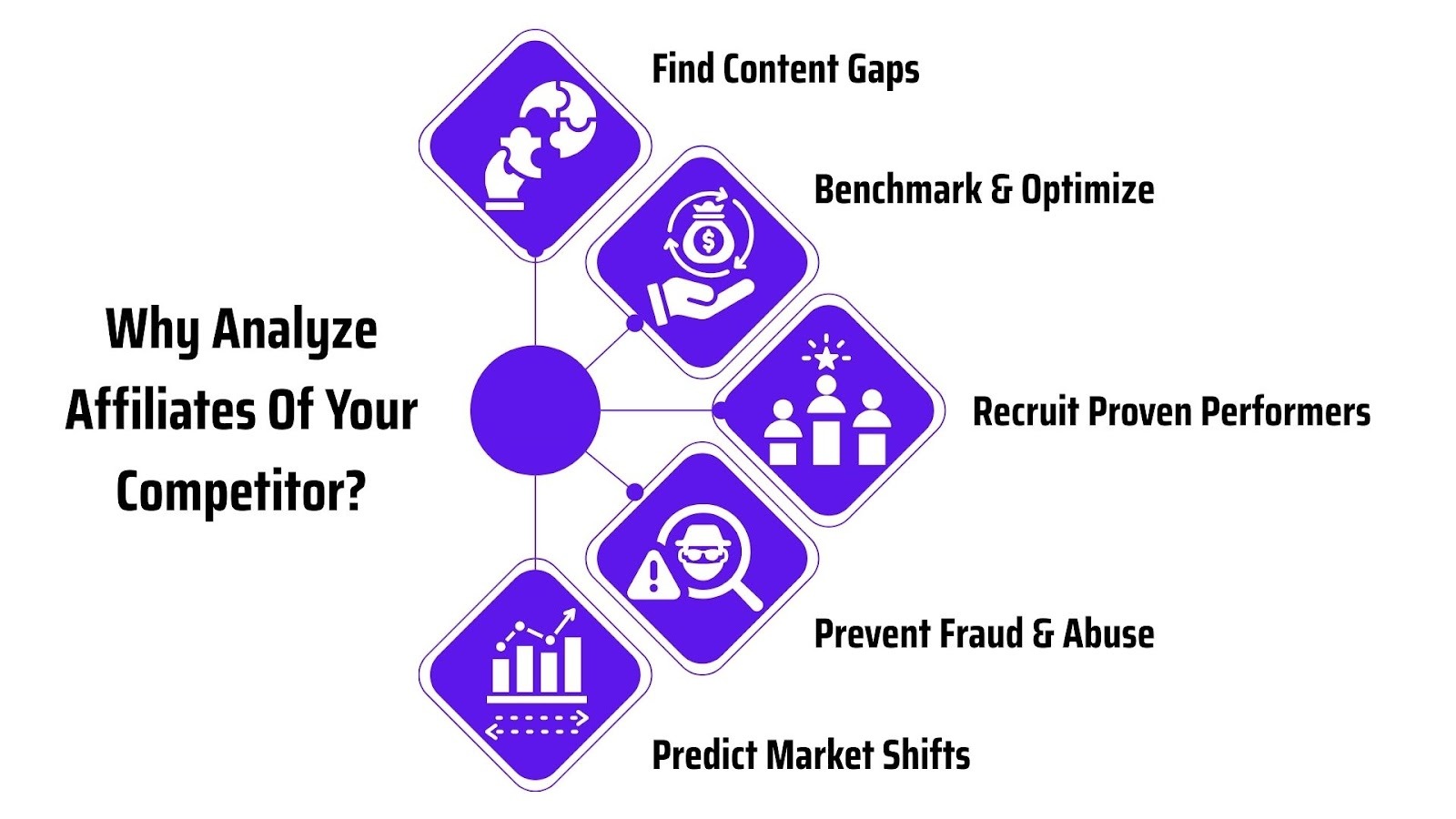
Strategic Positioning Advantage
This helps you check what’s working before you spend a dime.
You can see the exact commission rates, bonus structures, and sales angles your competitors use. This lets you spot content gaps.
Maybe no one is creating video tutorials for their product. That’s your wide-open door.
When you analyze the content affiliates produce, you can find areas where your brand can dominate. SERP analysis can help you target niches rivals are ignoring.
Higher ROI Decisions
Money talks. But smart money listens.
Why repeat your competitors’ expensive mistakes? If you see a rival has a low number of affiliates in a specific network, it could be a dud. You can avoid that.
Plus, analysis helps you focus on channels and resources that are already working for others. You can benchmark commissions efficiently.
For instance, “affiliate marketing gives an average return of $6.5 for every $1 spent”.
Not just that. You’ll learn that “SaaS products often pay affiliate commissions ranging from 20-70%”.
This helps you set competitive rates without overpaying.
Faster Affiliate Acquisition
Emerging affiliates often promote multiple programs.
However, the fastest-growing ones may not yet be exclusive. Detecting these early allows you to build relationships before the niche saturates.
Also, building an affiliate program from scratch is slow. Why start from zero? You can find proven performers who already understand your market.
Fresh creators are popping up daily. Over 50% of affiliates are new. It means there’s a content stream of potential partners ready for recruitment.
Monitor rivals' partnerships and social media mentions. And this helps you detect them before your competitors and connect with them.
Stronger Risk Protection
Not all affiliates play fair.
Some may use coupon abuse, misleading claims, or grey-hat tactics. Fraud is on the rise. Nearly 17-20% of traffic is fake. Such an offense costs the industry over $3.4 billion.
Tracking affiliates reveals-
-
Risky patterns and
-
Tools competitors use
That’s how it helps you prevent fraud. You can protect your brand and build a reliable network.
Adapting To AI Disruption
AI is here, and it’s changing the entire scene.
Affiliates now use AI to scale content creation at an insane rate. They pump out reviews, newsletters, and social posts faster than ever.
Analyzing competitor affiliates helps you understand how they use automation. That way, you can guess market shifts and adjust strategies accordingly.
Besides, it allows you to see new content formats and promotional angles emerging from AI.
Result: You can stay ahead of the curve.
Stats say “50% of affiliate programs will adopt AI for personalization and optimization within the next 3 years”.
6-Step Competitor Affiliate Analysis Framework
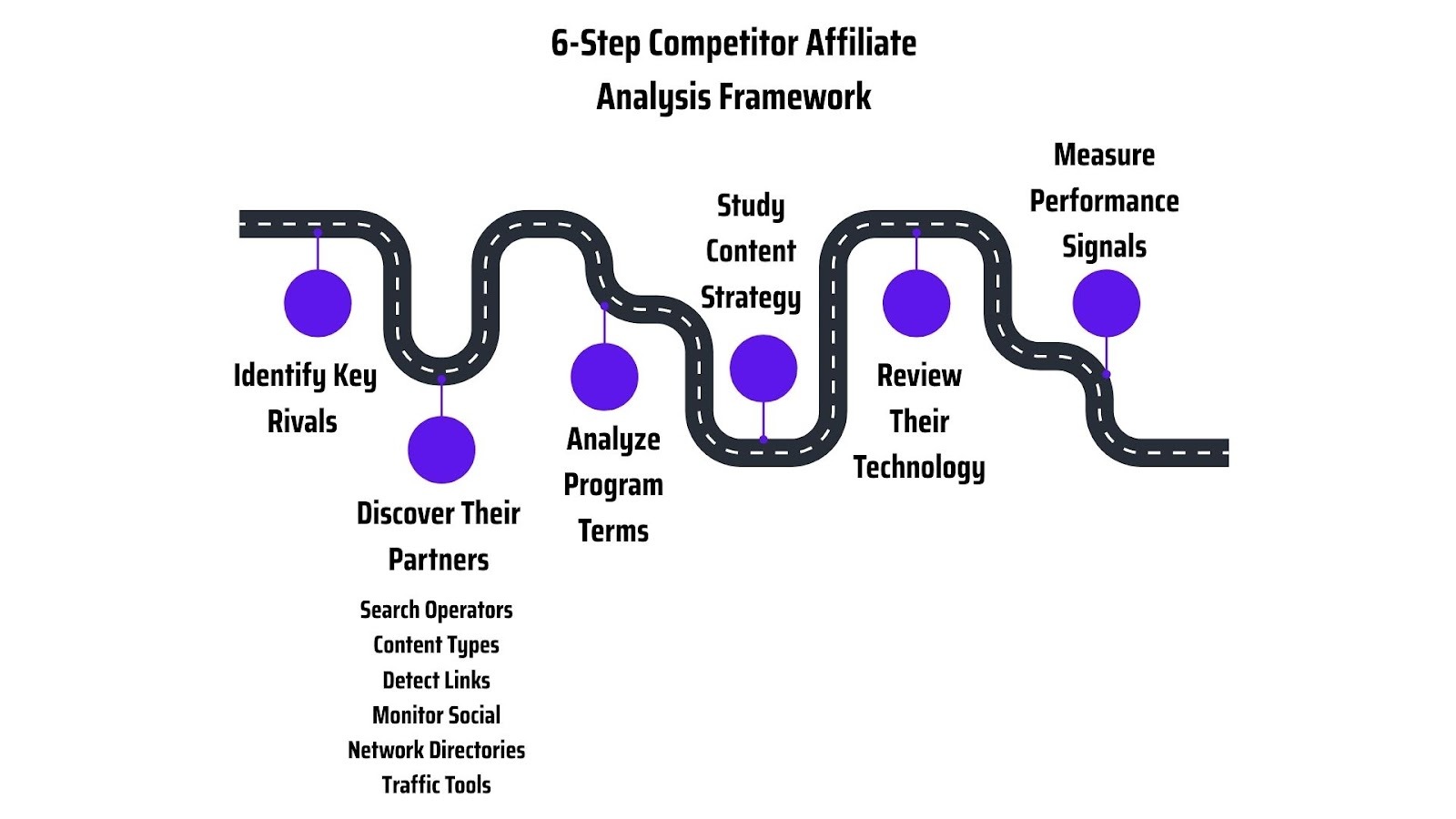
Step 1: Define Your True Competitor
You can’t spy on everyone. That’s a waste of time. Get a target list.
Look beyond your product competitors. Who else is trying to sell to your customers? Spot who really matters in your niche.
This includes
- Direct rivals: Offer similar products to your audience
- Indirect rivals: Solve the same problem differently
- Affiliate-specific rivals: Programs attracting the same pool of affiliates
Map these players across search, social media, and email.
Casting a wide net ensures you don’t miss hidden gems. That way, you can focus on competitors with affiliates worth recruiting.
Step 2: Find Their Affiliate Partners
Now, the main part.
2.1 Google Operator Hunting
Use search strings. It can be "best [competitor product]" review, "[competitor] vs ", or "[competitor] coupon". Reverse-search long-tail affiliate content.
Spot pages that are already promoting your competitors. This pulls up pages that are almost certainly affiliate-driven.
2.2 Look for 5 Content Types
Focus your search on key content types. For instance:
- Reviews: Detailed product evaluations with affiliate disclaimers.
- Comparisons: “X vs Y” or alternative product pages.
- Listicles: Top X lists packed with affiliate links.
- Coupon/Deal Pages: Dedicated pages promoting discounts.
- Influencers & YouTubers: Video creators sharing affiliate content.
2.3 Link Detection
Use tools like Ahrefs or SpyFu to analyze your competitor's backlinks.
Look for tell-tale signs of affiliate links in the URL. For example- “?ref= or ?aff_id=”.
Inspect code for hidden affiliate links.
2.4 Social Media Scanning
Search for your competitor's name or any affiliate activity on different platforms. It can be on TikTok, Instagram, Pinterest, and X.
Focus on creators doing "unboxings" or "reviews."
Monitor branded hashtags, sponsored content, and social listening trends.
2.5 Network Deep Dives
Browse public directories on major affiliate networks. For instance:
- Impact
- PartnerStack
- CJ Affiliate
- Awin
See if your competitor is listed. Public directories can reveal publishers across multiple networks.
2.6 Traffic Intelligence Tools
Use Semrush or SimilarWeb.
See who’s sending referral traffic to your competitors. These are often affiliates. Identify top-performing ones that are driving significant visits.
Step 3: Evaluate Program Terms
Play the undercover agent.
Sign up for their affiliate program if you can. Analyze the program terms:
- Commission rates and tiers
- Cookie durations
- Conversion metrics and EPC clues
- Traffic restrictions and approved channels
- Payment cycles and bonuses
This helps you craft better offers and attract top-performing affiliates.
Also, mark any special bonuses or restrictions. That’s your pricing sheet.
If they offer 5% commissions with a 30-day cookie, you can go with 7% with a 60-day cookie. See? You’re building a better offer.
Step 4: Review Content Strategy
What are the affiliates actually saying?
Study what content affiliates create for your competitors. Focus on
- Formats and depth
- Seasonal trends
- Messaging, angles, and hooks
- Email and social amplification
Read the top articles and watch popular videos.
- What angles do they use?
- What features do they highlight?
- What objections do they address?
- Is the content mostly text, or are there lots of videos?
This tells you what messaging resonates with your shared audiences. You can then provide your own affiliates with better content kits. That way, it fills in the gaps your competitors missed.
Result: Increasing conversion chances.
Step 5: Assess Technology Stack
Check what platforms and tools your competitors use to run their program. Focus on-
- Affiliate networks
- Tracking tools like TrackReward
- Fraud prevention methods
- Landing pages and funnels
- AI content usage and automation
See what kind of dashboard they provide to affiliates? Is it modern? Is it easy to use? Spot signs of other techs. Like AI content tools or advanced analytics.
A better tech stack can be a big selling point. If their reporting is clunky, you can offer a clean, real-time dashboard. This helps them track earnings easily. And you can win top affiliates.
Step 6: Measure Performance Signals
Track how well competitor affiliates perform.
Use tools to estimate-
- SERP rankings of their content
- Referral traffic estimates
- Engagement metrics like views and comments
- Market share and affiliate tier predictions
This ensures you target affiliates who drive meaningful traffic and conversions.
An affiliate with a high-traffic, highly engaged audience is a much bigger prize than one with minimal reach.
How To Use Your Competitor Insights
Data is useless without action.
Build A Stronger Value Proposition
You know what they offer. Now, beat it.
- Low commission? Offer more.
- Slow payout? Pay faster.
- Boring creatives? Provide stunning landing pages and video assets.
Give affiliates more reasons to switch or join your program. Remember, affiliates earn 21% higher AOV than other channels (Source: WeCanTrack).
So, giving them tools to succeed benefits both sides.
Target High-Potential Affiliates
Don’t just email everyone.
Be a sniper. Mark affiliates who are promoting your rivals but look underserved.
Maybe their content is great. Then again, it’s not getting much engagement from the brand.
Reach out and offer them personalized support.
Go with affiliates whose content aligns with your target group. Identify high-EPC niches or micro-influencers with active audiences.
This brings better engagement.
Develop A Sharper Positioning Strategy
You’ve seen the competitor's playbook. Now, find the holes.
Understand competitors’ angles. That allows you to differentiate.
For example,
If all their affiliates talk about price, focus on product quality, niche benefits, or sustainability. Give your affiliates a unique story and hooks to tell. One that highlights your strengths and competitors’ weaknesses.
WeCanTrack shows that “niche-aligned content boosts engagement by 50%”. So, positioning matters.
Upgrade Content Quality
See content gap? Fill it.
Let’s say your rival has text reviews.
- Create a library of high-quality video reviews and tutorials for the affiliates.
- Provide them with AI-ready content kits. Like pre-written email swipes or social media captions.
This makes their job easier. Remember,
“Affiliates with good dashboards see 5% better retention and 30% improved ad spend efficiency”.
So, providing data-driven content helps them perform.
Optimize Outreach Messaging
Your first email can’t be generic.
- Use competitor data. Craft personalized scripts that hit both emotional and practical motivators.
- Highlight clear incentives. It can be bonus tiers or exclusive deals.
- Keep messages short and focused.
- Add a single, obvious call-to-action.
For example:
“Loved your review on [Competitor Product]. We noticed you highlighted the battery life. Our product actually gets 20% more battery, and we offer a 25% commission. Would you be interested in testing a unit?”
This shows you’ve done your homework. It also makes the offer more enticing to that affiliate.
Essential Tools You Need
No, not a million. But you need the right tools.
Research Tools
SEMrush. Ahrefs. SimilarWeb. They help uncover competitors’ traffic, keywords, and backlink profiles.
Tracking & Analytics Tools
Get TrackReward. It helps monitor affiliate performance, conversions, and ROI.
Competitive Intelligence Tools
SpyFu. Adplexity. Anstrex. They reveal affiliate links, top content, and paid campaigns.
Social Monitoring Tools
Brand24. Mention. Native searches. These help you track hashtags, mentions, and influencer activity across multiple social media platforms.
Prospecting & Outreach Tools
Hunter.io. LinkedIn Sales Navigator. Email automation tools. They work to speed up contacting and managing potential affiliates.
Advanced Intelligence Strategies
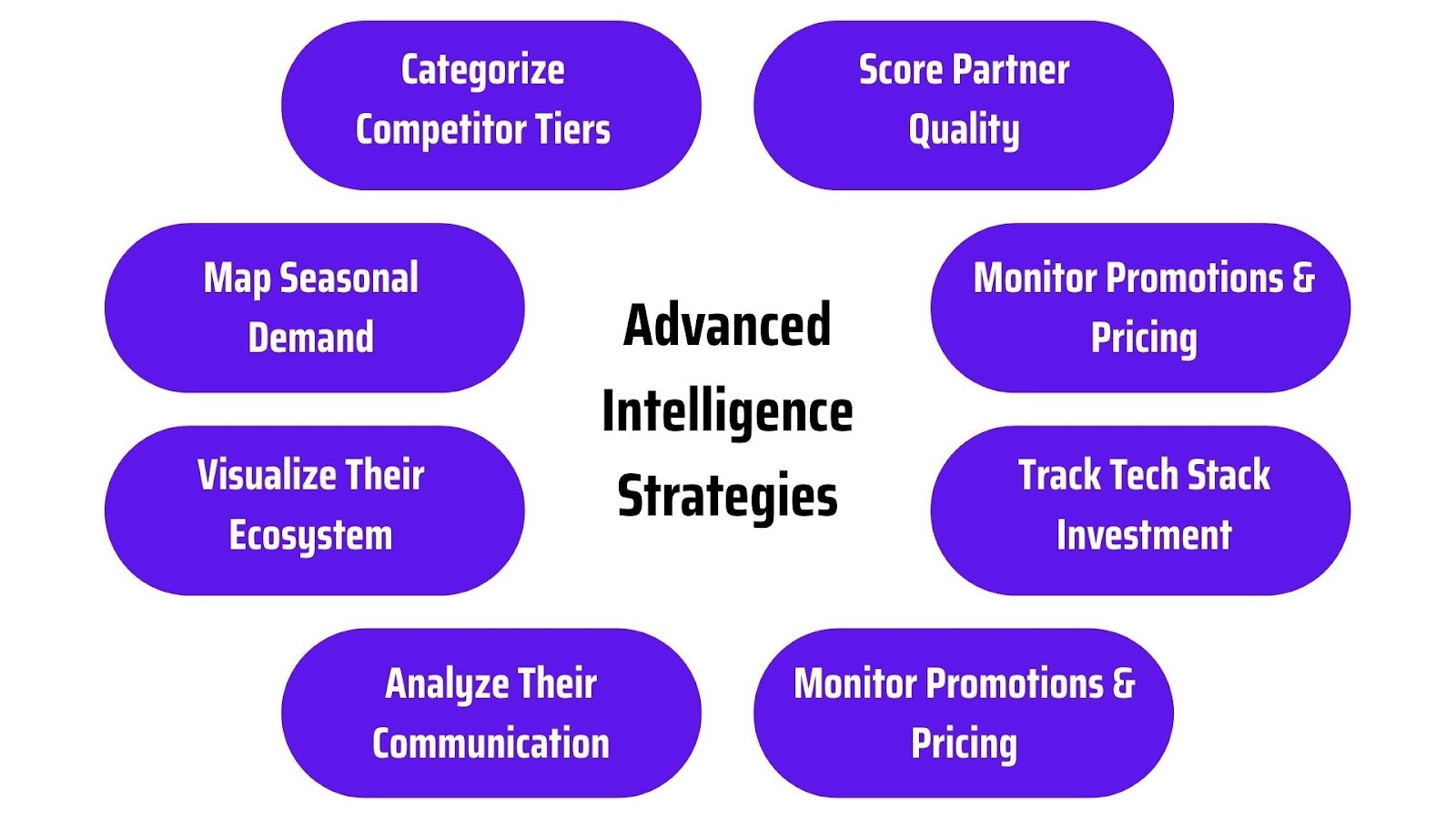
Three-Tier Competitor Model
Not all competitors are equal. Categorize them into 3 tiers:
- Direct Product Competitors: Same product or service.
- Content Competitors: Publishers and influencers competing for the same audience attention.
- Commission Competitors: Programs offering better terms that could lure affiliates away.
Tracking each tier ensures you understand traffic, messaging, and incentives from all angles.
Quality-Based Partner Scoring
Traffic alone doesn’t equal conversions. Score affiliates by:
- Content quality and originality
- Engagement metrics
- Audience overlap with your niche
- Consistency and freshness of posts
Mid-sized niche sites often drive better conversions than huge publishers. Long-tail keywords provide 42% higher CTR. So, targeting smaller but relevant affiliates pays off.
Seasonal Demand Mapping
Track competitor campaigns across holidays, product launches, or seasonal promotions. Note trends like
- Black Friday
- Back-to-school
- New Year campaigns
Align your outreach with these peaks. Plan your own campaigns to compete directly. This can capture attention when affiliates are most active.
Affiliate Ecosystem Mapping
Create a visual map of all your competitors’ affiliate relationships.
Identify:
- Core vs. peripheral partners
- Exclusive vs. non-exclusive relationships
- Geographic and niche distribution
This helps you see their network’s strengths and weaknesses.
Communication Pattern Analysis
Observe how competitors communicate with affiliates. Focus on
- Emails, newsletters, and chats
- Social updates and announcements
- Response speed and personalisation
This guides your own outreach. Plus, it shows how to engage partners more effectively.
Most interactions are automated and cold. You can win by being more human.
Promotion & Pricing Intelligence
Monitor
- Discount frequency
- Bundle offers and
- Upsell strategies
Note how affiliates position offers. Use this insight to create better campaigns or more attractive incentives.
Tech Stack Tracking
Keep tabs on the tools competitors use. It signals where they’re investing.
Focus-
Tracking platforms, automation tools, AI content usage, and fraud prevention.
80% of top affiliates use analytics for hyper-personalization. So, tech investments can signal areas to outcompete them.
Psychological Trigger Mapping
Analyze the messaging that motivates affiliates and the language they use. Ask
-
Do they focus on FOMO, security, or status?
Use these proven triggers in your own messaging.
Pitfalls To Avoid With Solutions
|
Pitfall |
Consequence |
Fix |
|
Over-Analyzing Everything |
Stalls action |
Focus on one competitor or niche each week. Use spreadsheets to track key metrics. |
|
Copy-Paste Strategy |
Ignores your unique strength |
Use insights as inspiration. Add your own unique twist and better offers. |
|
Shallow Data Interpretation |
Miss hidden patterns |
Dig deeper into content quality, engagement, and affiliate motivation. Track trends. |
|
Overlooking Emerging Players |
Lose high-growth affiliates |
Update your rival list monthly. Scan social media and networks for rising affiliates. |
|
Ignoring Affiliate Motivation |
Drives away better affiliates |
Personalize outreach. Highlight incentives, bonuses, and tools. |
How To Build A Competitive Intelligence System
This isn’t a one-time project. It’s an ongoing system.
Four-Week Action Plan
- Week 1: Discover competitors and affiliates.
- Week 2: Analyze terms and content.
- Week 3: Start engaging with targets on social media.
- Week 4: Launch your personalized outreach campaign.
Regular Monitoring
Schedule 30 minutes/week. Check for new affiliates or program changes.
Documentation
Use a simple shared spreadsheet or a Notion page. Log your findings. That way, your whole team can see them.
Team Collaboration
Make sure your marketing and sales teams know what the affiliates are saying. Their insights are gold.
Automation
Use your tools. Set up alerts for new competitor backlinks or brand mentions.
Measuring the Impact
How do you know it is working? Track these KPIs:
- Affiliate Activation Rate
- Revenue Growth
- Before-After Comparison
Future-Proofing Your Analysis
Adopt AI & Automation
Use AI tools. Scan for new affiliates. Analyze content at a scale you can’t do manually.
Widen Your Discovery Scope
Look at global competitors and adjacent niches for fresh ideas.
Upgrade Your Skills Continuously
The tactics that work today may not work tomorrow. Keep learning.
Adapt to Post-Cookie Tracking
As third-party cookies die, focus on building first-party relationships with affiliates. Use tracking software like TrackReward that doesn’t rely on outdated methods.
Unlock Smarter Affiliate Tracking
See Your Program's True Performance.
To effectively manage these partnerships, you need clear insight. Reliable affiliate tracking software helps you with that.
It features real-time data and robust tracking you need to keep your program profitable and your affiliates happy.
-
Get the clarity you deserve with TrackReward!
FAQs
How do you find affiliates?
Search competitor review/coupon pages. Use Ahrefs/Semrush to find referral traffic and backlinks. Scan affiliate networks, social platforms, and outreach lists. Prioritize creators with audience fit and proven engagement and conversions.
What is the highest-paying affiliate program?
It varies by industry. SaaS and finance affiliates often offer highest payouts, sometimes 20-70% recurring or fixed $100+ per sale. Top programs include high-ticket software, hosting, and financial services platforms.
How do I find out who my competitors are?
Start with customer research: who solves the same problem? Use keyword research, marketplaces, app stores, social searches, and SEMrush competitors report. Ask customers which alternatives they’ve considered and what market share.
Can Spyfu track competitor keywords?
Yes. SpyFu extracts competitors’ organic and paid keywords. It shows historical rankings, estimated monthly clicks, and ad spend. Plus, it reveals profitable keywords and PPC campaigns to replicate or outrank with context.